math 110a
algebra notes
3.1
rings
a ring is a nonempty set with two operations (addition & multiplication) that satisfy:
- closure of addition
- associativity of addition
- commutativity of addition
- existence of additive identity
- existence of additive inverses
- closure of multiplication
- associativity of multiplication
- distributivity
a ring is different from a field because it doesn’t guarantee:
- commutativity of multiplication
- existence of multiplicative identity
- existence of multiplicative inverse
we can extend the definition of a ring to define a commutative ring which is everything a ring is, with commutative multiplication.
we can extend the definition of a ring to define a ring with identity which is everything a ring is, with the existence of a multiplicative identity.
ring examples galore
- the set of even numbers, is an example of a commutative ring with the usual addition and multiplication as defined on the integers. we have an additive identity (0), but no multiplicative inverse or identity.
- the set of odd number, fails the first axiom. the sum of two odd numbers is not odd!
- the set is a ring with identity. in general, if is a commutative ring with identity, then the set of all matrices with entries in form a non-commutative ring with identity.
integral domain
an integral domain is a commutative ring with identity such that if the product of two elements is 0, then one of the elements has to be .
integral domain examples galore
is an integral domain. when is prime is also an integral domain.
fields
a field is a commutative ring with identity that also has multiplicative inverses.
theorem 3.1
given two rings and the cartesian product defined as follows ensures that is a ring as well.
if and are commutative rings, then is commutative as well. similarly, if and are rings with identities, so is .
subrings
when a subset of a ring also satsfies the properties of a ring, we call a subring of .
example:
let be the ring of all functions from to . then, the subset consisting of all continuous functions from to is a subring of .
theorem 3.2
suppose that is a ring and is a subset of such that:
- is closed under addition
- is closed under multiplication
then, is a subring of .
subrings example galore
- the set in forms a subring.
- the set is a subring of .
3.2
theorem 3.3
additive inverses are unique.
theorem 3.4
theorem 3.5
given , we have the following:
- ,
furthermore, if has an identity:
cuidado!
in a non commutative ring:
but in a commutative ring, we have:
theorem 3.6
let be a subset of a ring . then is a subring of if:
- is closed under subtraction
- is closed under multiplication
units
an element in a ring is called a unit if it has a multiplicative inverse
the only units in are and .
the units in are
every non zero element in a field is a unit
units in sets of matrices usually satisfy .
zero divisors
an element in a ring is called a zero divisor if:
- there exists a nonzero element such that or .
doesn’t necessarily need to be unique.
examples:
- are zero divisors in .
an integral domain contains no zero divisors by definition duhhhhh
theorem 3.7
cancelation is valid in any integral domain. if and , then .
theorem 3.8
every field is an integral domain.
the converse of this if false in general. for example, is an integral domain that is not a field, but this is true in the finite case as we see in the next theorem. patience is key my friend.
theorem 3.9
every finite integral domain is a field.
proof
let be our finite integral domain. we know that is already a commutative ring with identity. so it suffices to prove the existence of multiplicative inverses. since has a finite number of elements, let’s enumerate them as follows: . given some arbitrary element, , we want to show that it’s multiplicative inverse exists in .
now, consider all the pairwise products as follows: . we claim these are distinct elements. assume for the sake of contradiction there exists some distinct such that , but by cancleation law (theorem 3.7) we would get that which is a contradiction.
so we have listed all our elements of as follows but we don’t know what order this is. but we know that exists somewhere in this list. and thus, we’ve found a multiplicative inverse of an arbitrary element .
3.3
isomorphism
a ring is isomorphic to ring if we can conveniently relabel elements of one as the other and obtain the same addition and multiplication tables. rigorously,
is isomorphic to if there exists a bijective function such that
for all .
further, is called the isomorphism.
the set of matrices that take real entries of the form
is isomorphic to wtfffff
the complex conjugation map is another example of an isomorphism
homomorphism
a function is called a homomorphism if
a homomorphism may fail to be injective or surjective.
the zero map is a homomorphism!
the function given be because of how addition and multiplication are defined in .
is surjective, but not injective because ’s pre image could be or anything of the form for some integer .
theorem 3.10
let be a homomorphism of rings. then,
further, if is a ring with identity and is surjective, then:
- is a ring with identity
- if is a unit in , then is a unit in and
theorem 3.11
if is a ring homomorphism, then the image of is a subring of .
4.1
theorem 4.1
if is a ring, then there exists a ring containing an element such that and the following hold:
- is a subring of
- . this does not necessarily imply that is commutative!
- the set of all elements of of the form:
is a subring of that contains
- the representation of elements of is unique
- iff
the elements of are called polynomials with coefficients in and the elements, are called coefficients.
theorem 4.2
if is an integral domain and and are nonzero polynomials in then
corollary 4.3
if is an integral domain, so is .
corollary 4.4
let be a ring. if , , and are nonzero in , then we have
corollary 4.5
let be an integral domain and . then, is a unit in iff is a constant polynomial that is a unit in . in particular, if is a field, the units in are the nonzero constants in .
theorem 4.6
division algo equivalent
let . then there exists unique such that
either or
4.2
theorem 4.7
let with nonzero.
- if divides then divides for each nonzero
- every divisor of has degree less than or equal to
polynomial gcd definition
let not both zero. the gcd of and is defined as the monic polynomial of highest degree that divides both and
let . then:
- and
- if and then
theorem 4.8 (bezout)
let . then there is a unique gcd . furthermore, there are polynomials such that .
similarly, we can derive a division algorithm for polynomials. let , not both zero. perform division as follows:
where . then is the monic associate of the last nonzero remainder,
corollary 4.9
let and let . then the following are true:
- and
- if and then
theorem 4.10
let and assume and assume and are relatively prime. then, .
4.3
associates
we say an element is an associate of if for some unit
for example, in the associates of are
in the associates of are for non zero
irreducible polynomials
is irreducible if:
- is a non constant polynomial
- the only factors of are the nonzero constant polynomials and the associates of
theorem 4.11
a non zero polynomial is reducible iff it can be expressed as a product of two polynomials of lower degree.
theorem 4.12
for a non constant polynomial in the following are equivalent:
- is irreducible
- if then or
- if an irreducible polynomial divides a product of two things, then the polynomial has to divide one of those two things
- if then or is a nonzero constant polynomial
- if an irreducible polynomial can be written as a product, one of the two things in the product is a constant
note: being irreducible is sorta the “prime” equivalent in
corollary 4.13
if then for some in
theorem 4.14
every nonconstant polynomial is the product of irreducible polynomials. this factorization is unique in this sense:
if and then
- is an associate of for all
unique factorization domains
integral domains in which every non-unit element factors uniquely into a product of irreducibles are called unique factorization domains.
hierarchy
so generally speaking, if you start with an integral domain, here is how you get to a field:
- integral domain (no zero divisors)
- unique factorization domain (every element can be uniquely factored into “primes”)
- principal ideal domain (every ideal is principal)
- euclidean domain (division always gets you a quotient and a remainder)
- field (inverses always exist)
4.4
polynomial induced functions
usually given some polynomial induces a polynomial function. if then the polynomial induced function is where
insert normal definition of a root/zero for a polynomial
theorem 4.15
let and . the remainder when is divided by the polynomial is
theorem 4.16
let and . then is a root of the polynomial iff is a factor of in
corollary 4.17
a non zero polynomial of degree has at most roots in
this is not necessarily true for more general rings.
corollary 4.18
an irreducible polynomial of degree has no roots.
- the converse is generally not true. it is NOT necessarily true that if a polynomial has no roots, then it is irreducible.
corollary 4.19
let be a polynomial of degree or then is irreducible in iff has no roots in
corollary 4.20
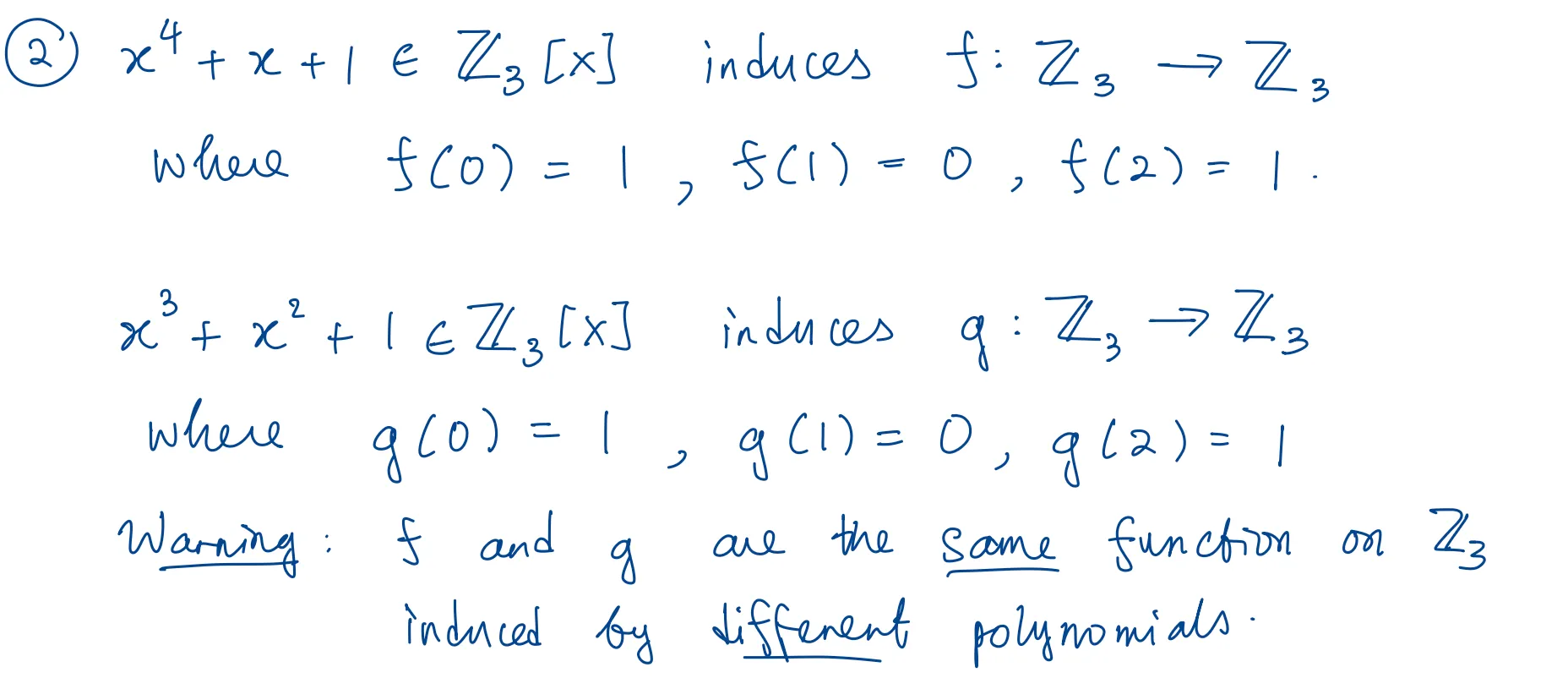
let be an infinite field and then and induce the same function from to iff in
this is not necessarily true for finite fields as seen below
4.5
is a subring of
for every there exists some such that
- basically that you can multiply with the of the denominators
- furthermore, if you have a root of , it is also a root of
theorem 4.21
let , if and the rational number in lowest terms is a root of , then and
lemma 4.22
let with . if is a prime that divides every coefficient of , then divides every coefficient of or divides every coefficient of
theorem 4.23
let . then factors as a product of polynomials in of degrees and iff factors as a product of polynomials of degrees and in
theorem 4.24
let be non constant. if there is a prime such that
then is irreducible in
theorem 4.25
let . let be a positive prime such that . if is irreducible in , then is irreducible in
- find some prime number such that it doesn’t divide the leading coefficient
- reduce your polynomial coefficients from to
- check irreducibility there
important if you do this and find out that your polynomial IS reducible in this gives you no conclusion for if this polynomial is reducible in
5.1
theorem 5.1
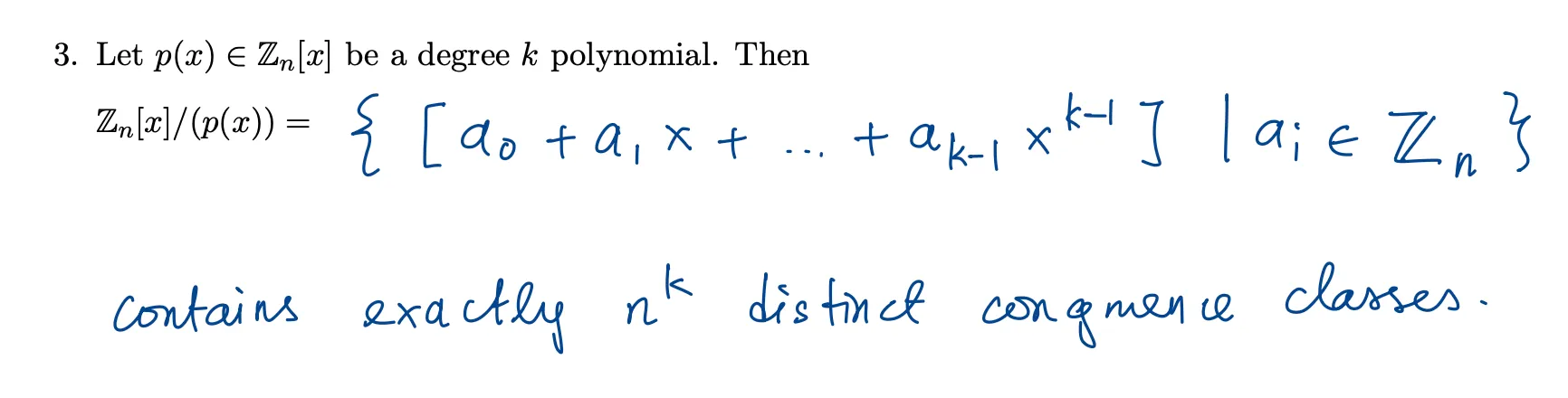
defines the congruence relation for polynomials (same shit as integers)
theorem 5.2
let be a non zero polynomial. assume and we have:
define a congruence/modulo class the same way we do in integers
theorem 5.9
given some non constant polynomial and if is relatively prime to then is a unit in
further, if is not relatively prime to and then is a zero divisor in
5.3
theorem 5.10
let be a non constant polynomial. equivalent:
- is irreducible
- is a field
- is an integral domain
theorem 5.11
let be an irreducible polynomial in . then is an extension field of that contains a root of
corollary 5.12
given a non constant polynomial , there exists an extension field of that contains a root of
6.1
ideals
let be a ring. a subring is called an ideal if and , then and
- double absorption () is only necessary when your ring is non commutative. if it’s commutative, then you just need to check one of them
the set consisting of just is the zero ideal. the whole ring is also an ideal.
theorem 6.1
is an ideal iff is closed under subtraction and satisfies double absorption
theorem 6.2
given a commutative ring with identity, and which is the set of all multiples of in , then is an ideal.
theorem 6.3
given a commutative ring with identity and some elements from . the set is an ideal in . this is denoted as
- such an ideal is called finitely generated
- principal ideal is when
- the generators of a finitely generated ideal don’t need to be unique!
every euclidean domain is a principal ideal domain. examples of principal ideal domains include .
congruence
we say that when
congruence relation
same shit as you do with integers and polynomials
congruence class notation
the set of all elements of that are congruent to an element is denoted as . this is just notation and does not mean that we are adding an element to an ideal. instead of writing , we write 💯
also, a congruence class modulo is also called a left coset of in .
theorem 6.6
let be an ideal in a ring , and let . then iff
corollary 6.7 67676767676767
let be an ideal in a ring , then two cosets of are either disjoint or identical.
- i think this is the same thing as whenever you do something like you don’t have two integers map to the same equivalence class unless they’re fr equivalent. i still struggle to see why this is corollary is brought up and two congruence class’s intersection would be non empty
the set of all cosets of is denoted

now define addition and multiplication just as we did with integers and polynomials
theorem 6.9 this is very general
- is a ring with addition and multiplication of cosets defined as we do with equivalence classes
- if is commutative, so is
- if has an identity, so does
back to homo
the image of a ring homomorphism is always a subring of , but not necessarily an ideal of
- example: , the integers are not an ideal in the rationals
theorem 6.10
let be a ring homomorphism, then is an ideal in
theorem 6.11
let be a ring homomorphism with kernel . then iff is injective.
theorem 6.12
let be an ideal in a ring . then the map given by is a surjective homomorphism with the kernel
is also called the natural homomorphism whatever tf that means
theorem 6.13
let be a surjective ring homomorphism with kernel . then the ring is isomorphic to
now, we want to determine conditions necessary to see when quotient rings are integral domains or fields. basically, generalize the notion of prime numbers, irreducible polynomials, to _______ 😱
6.3
prime ideal
let be an ideal. we say is prime if and whenever for some then or
if then contains a unit
theorem 6.14
an ideal is prime iff is an integral domain
theorem 6.15
let be an ideal in a commutative ring with identity , then is a maximal ideal iff the is a field.
corollary 6.16
in a commutative ring with identity, every maximal ideal is prime.